V-Care is a multi- specialty clinic. Clinic has facilities of PODIATRY, PHYSIOTHERAPY & OCCUPATIONAL THERAPY.
Tuesday, 2 August 2016
Monday, 28 September 2015
Other Problems
KNEE PAIN
![]() |
| Knee Pain |
![]() |
| Knee Deformities |
Most commonly people suffering from flat feet are more prone to knock knees (Genu Valgus) deformity in the knee joint which affects outer compartment of knee joint whereas people with high arch are susceptible to bow legs (Genu Varus) deformity which affect the medial compartment of the knee joint.
LIMB LENGTH DISCREPANCY (LLD) & BACK PAIN
The human body is an epitome of balance. If there is any deviation from this balanced state the system go into malfunction. The same holds true while considering the length of lower limb. If there is any difference in the length of the two limbs, it alters the position of the pelvis. This in turn affect the spine resulting in Scoliosis i.e. tilting of the spine on one side.In severe cases along with the spine the ribs also undergo rotation causing a rib hump. Once the vertebral bodies start rotating the spinous processes deviate more & can even compromise the respiratory capacity in sever case.
Treatment:-
If the reason for the scoliosis is LLD then it is advisable to detect the exact length of discrepancy. This can be corrected by adding the exact amount of compensation in the footwear to prevent further deterioration of the spine. Another important aspect is physical therapy intervention to maintain the flexibility & strength.
ACCESSORY NAVICULAR BONE
![]() |
| Accessory Navicular Bone |
![]() |
| Accessory Navicular Bone |
Causes:-
- Recurrent trauma to the ankle or foot such as ankle sprain.
- Improper size & pattern of footwear which causes friction against the extra bone.
- reduction in arch.
- Injury to Tibialis posterior tendon.
Symptoms:-
- Redness & swelling over the inner side of the foot in the arch area.
- Pain on palpating the area of extra bone.
- Pain while walking & standing activities.
CALCANEAL APOPHYSITIS
An apophysis is a growth plate which is present at the end portion of the bone when there is no accompanying bone, Calcaneal apophysitis is an inflammatory condition which affects the growth plate present in the heel bone (Calcaneum). It usually occurs in kids falling in the age group of 8-14 years as till the age of 14 years the growth plate continues to grow. Repeated stress or trauma to this sensitive area results in inflammation & damage to the growth plate.
Causes:-
It is most commonly seen in kids participating in sports which result in high impact over the heel area which ultimately damage the still underdeveloped growth plate. Furthermore kids who have other alignment issues such as flat feet or high arch are more susceptible to this damage.
Symptoms:-
- Pain in the heel area.
- Excessive pain on squeezing the sides of heel.
- Pain on standing or walking which become worse as the time increases.
- Limping
- Inability to perform activities such as running, jumping & skipping.
Thursday, 17 September 2015
CORNS AND CALLUSES
![]() |
| Painful Corn |
![]() |
| Corn & Calluses |
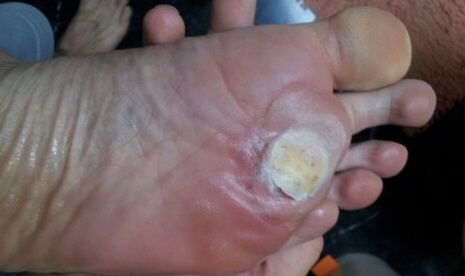
The development of corns and calluses is independent of any other systemic disease such as diabetes and can affect almost anyone. Although if a diabetic patient incurs corn or a callus then it should be dealt with more precaution to avoid complications such as infection or wound.
Treatment:
As elaborated above, calluses are the result of undue pressure. Therefore unless this pressure is reduced, the callus or corn will keep or re-occurring. Stooping friction & offload the corn by using orthotic corrections as per the Podiatrist's advice is the only safer treatment.
It is strictly un-advisable to use corn caps as it contains Salicylic Acid which is harmful to the normal & healthy skin surrounding corn thereby increasing the diameter of the corn.
![]() |
| Corn Cap results |
![]() |
| Don't use corn cap & stop doing bathroom surgery |
Success Story Of recurrent Corns-1
TIBIALIS POSTERIOR TENDINOPATHY
Tibialis Posterior Tendinitis/ Tendinopathy is also know as Posterior Tibial Tendon Dysfunction (PTTD). The tendon of Tibialis posterior muscles is one of the most important supporting structures for the arch of the foot. This muscle originates from fibula & inserts over the medial cuneiform & navicular bone.
When the function of this tendon is impaired, it alters the walking pattern & is unable to provide adequate support to the arch. If left untreated overtime this muscle loses it's integrity & the arch collapses. This is termed as 'Adult acquired flat feet.
If the person continues to walk in this pattern it leads to outward deviation of toes & rolling inwards (Pronation). Therefor early treatment is advisable.
Treatment
When the function of this tendon is impaired, it alters the walking pattern & is unable to provide adequate support to the arch. If left untreated overtime this muscle loses it's integrity & the arch collapses. This is termed as 'Adult acquired flat feet.
If the person continues to walk in this pattern it leads to outward deviation of toes & rolling inwards (Pronation). Therefor early treatment is advisable.
Treatment
- Reduction of inflammation over the tendon.
- Use of ankle brace while walking during the initial period to support the tendon & allow it to heal.
- Physical Therapy exercises to reduce pain & strengthen the muscle to prevent further complications.
- Use of corrective orthotics to prevent the arch from collapsing completely.
Friday, 11 September 2015
ACHILLES TENDINITIS
A Tendon is a connective tissue present at the end of the muscle & connect muscle to the bone. The Achilles tendon connects the calf muscle to the heel bone.
Inflammation of this tendon is termed as Achilles Tendinitis. It is characteristically an overuse injury. It results due to a sudden or gradual increase in repetitive activity which involves function of Achilles. But since the tendon is not exercised to bear the exerted stress, its fiber go into micro trauma. This micro trauma continues to accumulate overtime & results in injury to the tendon as the the body does not get the adequate time & rest required for healing.
Achilles tendinitis is more common in athletes involved in sports which require running & jumping activities. Therefore any such athletes who undergoes less than appropriate conditioning are more prone to such injury.
Apart from them another population in whom such common are the 'weekend athletes' i.e. who play sports occasionally without proper training. Another important variant is the type of shoes used while indulging in high impact sports. Not many people are aware about this predicament & hence damage their body. Therefore it is vital to select shoes which suit your arch type.
Symptoms:
- Pain & swelling over the calf region or above the heel bone.
- Early morning stiffness on walking after rest.
- Difficulty on standing & walking for long duration.
Ankle Pain
Ankle pain is a wide term that includes
many causes which predispose to the pain in the ankle joint, however some of
the common causes of ankle pain may include fracture, tendon inflammation,
arthritis, gout, ligament injuries and the list goes on….
But the most common and predominant cause
of ankle pain, include injury to the ligaments that surround the ankle joint
which could otherwise be called ankle sprain or ligament sprain.
What are ligaments??
Ligaments are band of tough elastic tissue around our joints. They connect bone, give our joints support, and limit their movement.
So, when there is an excessive movement to the joint, the ligaments gets stretched or eventually tears which leads to ligament sprain.
ANKLE SPRAIN
Similarly when excessive stretch is put to the ligaments of the ankle
which could either be caused due to faulty alignment of the foot, walking
patterns on different terrains or sudden ankle twist as in the case of sport
injuries can cause ankle sprains.
There are medial (Inner side) ligaments (deltoid) and the lateral (outer side) ligaments that surround the ankle joint. The most common injury is at the lateral ligament is less common which is caused due to outward rotation of the foot (Eversion).
There are 3 grades of sprains depending upon the severity of injury.
The most commonly affected ligament is the anterior talo-fibular ligament & gets affected due to injury resulting in inward rotation (inversion) of the ankle.A less common type of ankle sprain occur due to outward rotation (eversion) of ankle & injuries the deltoid or medial ligament.
Foot arch is responsible for supination (High arch) & pronation (Flat Feet) throw ankle more outer
border or inner border of foot respectively. Chances of inversion ankle sprain in supinator which is more common & eversion ankle sprain in pronators are more.
Causes:
- Trauma or fall is the most common cause.
- Weak musculature.
- Increased laxity &/ reduce stability of ligaments.
- Walking in high heels or footwear with inappropriate platform.
- Walking or running on uneven surface.
- Faulty foot alignment.
- Impaired balance.
Symptoms:
- Pain & swelling over ankle.
- Inability to bear weight over affected limb.
- Stiffness in the joint.
Treatment:
The most basic approach is to follow the PRICE protocol. This abbreviation stand for the following:
P- Protection- which can be attained by use of brace while walking or standing activities. Selection of the brace should be according to the grade or
level of ankle sprain.
R- Rest- which is required for allowing healing. If the patient attempts to walk
with the present injury then the chances of further damage are high.
I- Ice pack- This helps in reduction of inflammation & helps in draining out of the end product which helps in pain reduction.
C- Compression- which also can be achieved by the use of braces that provide adequate support.
E- Exercise- which is the most important aspect.
- Physiotherapy for the ankle sprain includes strengthening of the weakened muscles around the ankle joint. Muscles around the ankle joint plays a very important role in maintaining the integrity of the ankle joint).
- Balance Training
- Proprioceptive Training
Similarly as mentioned earlier, the type of the foot (Flat Feet / High Arch) also plays a very important role in stability. Depending on the type of Arch, shoe modifications with proper insoles and firm ankle grip is important to prevent re-occurrence of the Ankle Sprain.
Apart from the above if the cause of ankle sprain is faulty foot alignment then it is necessary to administer appropriate treatment for the cause or consult podiatrist.
Thursday, 10 September 2015
HAMMER TOES
Hammer toe is a deformity which affects the second, third, fourth & fifth digit resembling a hammer. It affects both the proximal & distal interphalangeal joint.
It occurs most commonly due to ill fitting or improper size of shoes. While buying shoes people consider only the length variable & do not pay attention to the width of the shoe. Hence they end up buying shoes which are narrow or too long. In addition while buying shoes we usually consider the length of the great toe as it is the longest but in some cases the other toes are longer than the great toe. Hence the longer toe is always cramped inside the shoe. This is another other important factor that leads to hammer toe deformity.
The digit that undergoes this deformity is also susceptible to problems such as pain & inflammation, corns & calluses & infection.
Subscribe to:
Posts (Atom)