Showing posts with label Diabetic foot. Show all posts

Tuesday, 25 July 2017

HOW PODIATRY: AN INNOVATIVE SOLUTION TO ANKLE, FOOT AND LOWER LIMB PROBLEMS


Podiatry must definitely be a new word for many people among us. But before we get into the details of Podiatry, let's answer the question that why is there a need to gain knowledge about foot or problem related to it ??? As we have commonly known that while constructing any structure it is essential for the basement to be strong and sturdy. Taking this fact into consideration, we infer that when it comes to the Human body, the Foot is that important base which is needed to perform the human functions of mobility and stability. There are 26 bones, 33 Joints, 107 Ligament & 19 Muscles which are intricately connected to each other to complete the anatomy of foot.  Hence, if the alignment of the base i.e. the foot is affected it will have repercussion that will affect our postural alignment. But unfortunately, most often, this amazing structure is neglected & not given the care & attention it needs.

Standing and walking are integral part of our daily routine. However, people do not give heed to foot problems until it hampers their standing or walking routine severely. This is the fundamental reason foot problems are not easily treated and hence are ignored. However, ignorance is not always bliss. Since our feet & the ability to move is what demarcates the difference between INDEPENDENCE & DEPENDENCE.

Podiatrist is a doctor who specialized in treating conditions related to foot, ankle and lower limb. Consequently, the medical science of diagnosis and treatment of foot, ankle and lower limb related problems called Podiatry. Although still an alien term, Podiatry has been in practice since early 1900s in America, Australia & Europe.


FOOT SCREENING
Now that we are acquainted to & agree on the importance of foot. Let’s get an insight on some common signs which will help you to identify any foot related problem and screen yourself. So you can check for yourself for following signs.

Other Toes
LOW BACK PAIN AND KNEE PAIN


The human musculoskeletal system can be considered facsimile to a chain link. If the position of any one end is changed or if anyone links, is broken, then it will damage the entire chain link.  Thus, altered foot alignment can result in knee pain & back pain. Therefore, there is an interconnectivity between the foot, knee and spine.


Diabetes is a multi system metabolic disorder which even has its implications on the normal functioning of foot. However, the treatment of foot complications related to diabetes is an entirely different domain (elaborated in previous article)
    It causes two major problems in feet

WHAT DO YOU DO NOW?

In case you have incurred any of the above enlisted problems, who do you approach for the same. The answer is a Podiatrist.

HOW DOES IT WORK?

Before starting the treatment it is essential to identify the root cause, which can only be known after a thorough assessment. This assessment involves the following-
       Understanding the patient’s complaints & lifestyle.
       Visual inspection of FEET- Skin Condition, Colour, Corn/Callus/Ulcer
       Gait Analysis.
       Foot sensation.
       Measure foot size- Length & width.
       Inspection of the patient’s footwear.

THE INNOVATIVE SOLUTION
Once you understand the main reason of the problem, Podiatry line of treatment includes following-
  1. Shoes: Appropriate shoes as per patients problem &  lifestyle demand, Doctor will guide you about sports shoe specifications, size & other details.
  2. Prescribe corrective Orthotics:
The main solution is corrective Orthotics (also known as insoles). Use of such orthotics helps re-align the body in a corrected posture & thus provides a long-term solution without any side effects.

COMMON FOOT RELATED CONDITIONS WHERE PODIATRY CAN HELP:


Thursday, 17 September 2015

CORNS AND CALLUSES


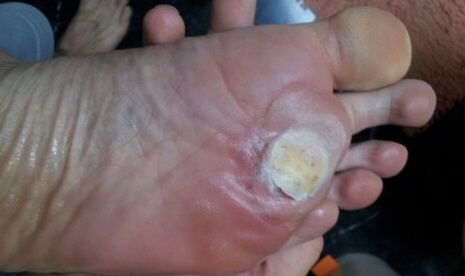
Painful Corn
Calluses are an area of hard skin that becomes tough due to exposure to excessive friction, pressure, or irritation. Callus can occur anywhere in the body which exposed to undue friction. The most common area is the sole of the feet, great toe & fifth toe. There are certain areas over our sole which bear more weight compared to the others. This is the area that undergoes more friction with the walking surface or the footwear & over time develops into a callus. These areas of more pressure are dependent on our arch & walking pattern & differ for every individual.

Corn & Calluses
When a callus has been long-standing, it converts into a Corn. A Corn is deeply rooted & can be considered similar to a funnel i.e. it has a narrow & deep-seated root & a broad base. Most often corns are painful & render walking & standing quite difficult even for the daily tasks.
The development of corns and calluses is independent of any other systemic disease such as diabetes and can affect almost anyone. Although if a diabetic patient incurs corn or a callus then it should be dealt with more precaution to avoid complications such as infection or wound.

Treatment:

As elaborated above, calluses are the result of undue pressure. Therefore unless this pressure is reduced, the callus or corn will keep or re-occurring. Stooping friction & offload the corn by using orthotic corrections as per the Podiatrist's advice is the only safer treatment.
It is strictly un-advisable to use corn caps as it contains Salicylic Acid which is harmful to the normal & healthy skin surrounding corn thereby increasing the diameter of the corn.
Corn Cap results
It is also wise to avoid performing any bathroom surgery for corn removal as the chance of infection is quite high.
Don't use corn cap & stop doing bathroom surgery

Success Story Of recurrent Corns-1


Monday, 29 December 2014

FLAT FEET: All You Need To Know ?


"The human foot is a masterpiece of engineering & a work of art."
                                                                                                           -Leonardo Da Vinci


The human foot consists of 26 bones, 33 joints, 107 ligaments & 19 muscles which work together to balance your whole body. No wonder this great artist has named it a masterpiece 1/4 of all bones in the human body are in the feet. Standing in the kitchen for cooking, walking down to buy vegetables playing any sport, or dancing are all the activities we can do because of our feet. Healthy feet are key to an active lifestyle. Human feet are designed to walk on natural surfaces like soil & sand, but instead of that, we are walking on hard surfaces like pavements or marble. That's why the incidence of foot problems. Out of all flat feet is the most common & unnoticed problem. If is it not diagnosed at the right age, it can lead to serious complications in the future. I get many patients saying, " My physiotherapist told me, I have flat feet & my family doctor says I don't have flat feet, I don't know what exactly flat feet mean...!"


Flat Feet
What is Flat Feet ?
We have a small gap on the inner side of our feet when we stand, when this gap is not there it's called flat feet. Everybody is born with flat feet, as a child starts walking his/ her arch starts developing. First, five years of age are crucial for arch development.

Effect OF Flat Feet On Posture:
All joints in our body work together. As feet are base of our body it affects entire posture. Following image will give you clear idea about how flat feet can affect alignment of all proximal joints.

Effect of Flat Feet


Causes:
Knee Pain
  • Ligament laxity.
  • Muscle weakness/ Hypotonia of muscles.
  • Fracture/ trauma around ankle joint.
  • Family history.
  • Obesity.
Symptoms:
  • Tired achy legs.
  • Heel pain, Knee pain & back pain.
  • Recurrent ankle sprain (Poor Balance)
  • Early osteoarthritis of joints.
  • Corn & Calluses etc.


Treatment:

Custom-made orthotics are the main line of treatment for flat feet. People always try to get some off
the shelf orthotics & course it doesn't help their problem. Orthotics correction should be based on lots of variables like the severity of flat feet, age, weight, lifestyle, alignment of proximal joints, etc. Thus shelf things are not advisable. A Podiatrist is a right person to prescribe the orthotics.

     Podiatry is a branch of medicine specializing in ankle & foot problems. A Podiatrist doctor will do a thorough assessment of your alignment, diagnose the problem & then provide a customized solution for the same.
After certain age flat feet are not correctable but orthotic intervention can prevent further damage.


Shoe Test


Good supportive shoes are recommended for flat feet. Criteria for supportive shoes are rigid soles & firm ankle control. One should not able to twist (Torsion Test) & or bend (Flexibility Test) easily. Usually spots shoes are the best supportive shoes. For a person with flat feet, anti-pronation shoes are recommended.

Exercise:
To strengthen foot & ankle muscles & maintain an ideal weight.

Case Study

Testimony