Showing posts with label Foot Care Clinic. Show all posts

Saturday, 27 January 2018

SUCCESS STORY OF RECURRENT CORN 1

SUCCESS STORY OF RECURRENT CORN

25 Years old young man working in restaurant as a manager came with complaints of three painful recurrent corns since 3 years. He needs to stand a lot as he was floor manager in five star hotel. He needs to stand at least 6-8 hours every day.

ASSESSMENT REVEALS:
  • Excessive forefoot pressure.
  • Medial Arch- Pronounced Bilaterally
  • Transverse arch- Reduced Bilaterally
  • Subtalar Joint- Supinates statically & dynamically
  • Corns- Three corns at 1st, 3rd & 5th Metatarsal heads
FOOT SIZE
  • Right- 8 Wide to Extra-wide
  • Left- 7 Extrawide
DIAGNOSIS- Corns with Pes Cavus foot type

CLINICAL REASONING:

Following are the reasons for corns in this case,
  • Week Transverse arch had increased fore foot pressure.
  • Both the foot sizes are different (Left foot is smaller than right)
He was wearing US 9 size shoes which was medium width. Left foot was sliding more inside the shoes resulted in more friction & corns.

Bio-Orthotic
TREATMENT & ADVISE:
  • Treatment started with targeting to offload the corn area.
  • Prescribed ready to wear orthotic footwear with metatarsal; raise for home wear.
  • Given Medium Density prefabricated custom orthotics (Bio-Advance insole) to use in his formal shoes.
Follow Up: After 15 Days
Corns are not hurting anymore when he wears corrections. Also recommended wide width formal shoes.
After three months corns healed completely.
After five months: even marks of the corn disappear.
TESTIMONIAL
"I came to V-Care Clinic about year back. In lot of pain & frustration ailing with three corns in my left sole. I had consulted with three doctors, endless trial & errors done. One of doctor even advised for surgery. One day magically I came across V-Care clinic on Google. After few hours of research on Podiatry. I decided very apprehensively to visit.
The first visit was what changed everything!!
The analysis & prescription of my problem by Dr. Sarika & Dr. Vilas was amazing. I am sure Sherlock Homes would be surprised. The warmth & the dedication is second to none. The meticulous explanation of the problem & its cure is commendable. I wish the V-Care team all the best & hope their quest of relieving people from pain goes on forever.
I cannot express my gratitude in words to Dr. Sarika & Dr. Vilas" 
Online Feedback

Thursday, 17 September 2015

CORNS AND CALLUSES


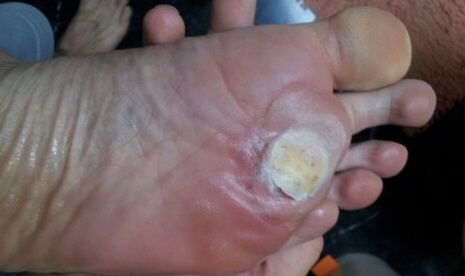
Painful Corn
Calluses are an area of hard skin that becomes tough due to exposure to excessive friction, pressure, or irritation. Callus can occur anywhere in the body which exposed to undue friction. The most common area is the sole of the feet, great toe & fifth toe. There are certain areas over our sole which bear more weight compared to the others. This is the area that undergoes more friction with the walking surface or the footwear & over time develops into a callus. These areas of more pressure are dependent on our arch & walking pattern & differ for every individual.

Corn & Calluses
When a callus has been long-standing, it converts into a Corn. A Corn is deeply rooted & can be considered similar to a funnel i.e. it has a narrow & deep-seated root & a broad base. Most often corns are painful & render walking & standing quite difficult even for the daily tasks.
The development of corns and calluses is independent of any other systemic disease such as diabetes and can affect almost anyone. Although if a diabetic patient incurs corn or a callus then it should be dealt with more precaution to avoid complications such as infection or wound.

Treatment:

As elaborated above, calluses are the result of undue pressure. Therefore unless this pressure is reduced, the callus or corn will keep or re-occurring. Stooping friction & offload the corn by using orthotic corrections as per the Podiatrist's advice is the only safer treatment.
It is strictly un-advisable to use corn caps as it contains Salicylic Acid which is harmful to the normal & healthy skin surrounding corn thereby increasing the diameter of the corn.
Corn Cap results
It is also wise to avoid performing any bathroom surgery for corn removal as the chance of infection is quite high.
Don't use corn cap & stop doing bathroom surgery

Success Story Of recurrent Corns-1


Friday, 11 September 2015

Ankle Pain

Ankle pain is a wide term that includes many causes which predispose to the pain in the ankle joint, however some of the common causes of ankle pain may include fracture, tendon inflammation, arthritis, gout, ligament injuries and the list goes on….

But the most common and predominant cause of ankle pain, include injury to the ligaments that surround the ankle joint which could otherwise be called ankle sprain or ligament sprain.

What are ligaments??

Ligaments are band of tough elastic tissue around our joints. They connect bone, give our joints support, and limit their movement.
So, when there is an excessive movement to the joint, the ligaments gets stretched or eventually tears which leads to ligament sprain.

ANKLE SPRAIN

Similarly when excessive stretch is put to the ligaments of the ankle which could either be caused due to faulty alignment of the foot, walking patterns on different terrains or sudden ankle twist as in the case of sport injuries can cause ankle sprains.

There are medial (Inner side) ligaments (deltoid) and the lateral (outer side) ligaments that surround the ankle joint. The most common injury is at the lateral ligament is less common which is caused due to outward rotation of the foot (Eversion).


                There are 3 grades of sprains depending upon the severity of injury.

The most commonly affected ligament is the anterior talo-fibular ligament & gets affected due to injury resulting in inward rotation (inversion) of the ankle.
A less common type of ankle sprain occur due to outward rotation (eversion) of ankle & injuries the deltoid or medial ligament.
Foot arch is responsible for supination (High arch) & pronation (Flat Feet) throw ankle more outer
border or inner border of foot respectively. Chances of inversion ankle sprain in supinator which is more common & eversion ankle sprain in pronators are more.

Causes:

  • Trauma or fall is the most common cause.
  • Weak musculature.
  • Increased laxity &/ reduce stability of ligaments.
  • Walking in high heels or footwear with inappropriate platform.
  • Walking or running on uneven surface.
  • Faulty foot alignment.
  • Impaired balance.
Symptoms:
  • Pain & swelling over ankle.
  • Inability to bear weight over affected limb.
  • Stiffness in the joint.
Treatment:

The most basic approach is to follow the PRICE protocol. This abbreviation stand for the following:

P- Protection- which can be attained by use of brace while walking or standing activities. Selection of the brace should be according to the grade or level of ankle sprain. 

R- Rest- which is required for allowing healing. If the patient attempts to walk with the present injury then the chances of further damage are high.

I- Ice pack- This helps in reduction of inflammation & helps in draining out of the end product which helps in pain reduction.

C- Compression- which also can be achieved by the use of braces that provide adequate support.

E- Exercise- which is the most important aspect. 
  •  Physiotherapy for the ankle sprain includes strengthening of the weakened muscles around the ankle joint. Muscles around the ankle joint plays a very important role in maintaining the integrity of the ankle joint).
  • Balance Training
  • Proprioceptive Training

Similarly as mentioned earlier, the type of the foot (Flat Feet / High Arch) also plays a very important role in stability. Depending on the type of Arch, shoe modifications with proper insoles and firm ankle grip is important to prevent re-occurrence of the Ankle Sprain.

Apart from the above if the cause of ankle sprain is faulty foot alignment then it is necessary to administer appropriate treatment for the cause or consult podiatrist.


Friday, 5 December 2014

Diabetic Foot & Podiatry

Active Lifestyle
India is becoming the "Diabetes capital of the world". Currently, the number of diabetic patients in India is around 40.9 million & is expected to rise to 69.9 million by 2025. The effect of diabetes on the heart, kidney & eyes is very well known. 
So the aware population tries to adopt an active lifestyle. But they are unaware of the fact that diabetes can even affect their feet. This un-noticed complication is known as Diabetic Neuropathy, which can turn to be the biggest barrier to achieving an active lifestyle. 60 - 70 %  of those with diabetes develop peripheral neuropathy. 20% of those develop a foot ulcer.

Every 20 seconds, a limb is lost as a consequence of diabetes.

How Diabetes can hurt your feet...?

Diabetes causes two problems that can hurt your feet.
DIABETIC NEUROPATHY
With damaged nerves, you might not feel pain, heat, or cold in your legs & feet. A sore or cut on your foot may get worse because you do not know it is there.

SYMPTOMS:

  • Burning, tingling sensations (worst in night).
  • Numbness or insensitivity to pain or temperature.
  • Extreme sensitivity to touch, even light touch.
  • Sharp pain sensation & cramps.
  • Loss of balance & coordination.

PERIPHERAL VASCULAR DISEASE (P.V.D.)
The second problem happens when not enough blood flow makes it hard for a sore or infection to heal.

SYMPTOMS:

  • Numbness & swelling in feet.
  • Coldness of legs.
  • Heaviness in legs or cramps, usually more at night.
  • Vicious Circle of Diabetes
  • Discoloration of skin.

These two problems can work together to cause a foot problem. While standing & walking certain areas of the foot are subjected to excessive pressure called "PRESSURE AREAS". These areas are prone to ulceration. Once the ulcer is developed, it causes a restriction in mobility & results in an increased sugar level. A person is trapped in a vicious circle.

WHAT IS THE SOLUTION...?

All these complications can be prevented & treated with the patient's education & the help of "Podiatry Doctor"(Foot Doctor).
Podiatry
Interventions
"Podiatry is a branch of medicine devoted to the study of diagnosis & treatment of disorders of the foot, ankle & lower limb." 
Podiatrist's aim is to improve mobility & quality of life, by following ways:
Conducting a thorough clinical evaluation of foot & lower limb.
Gait Analysis.
Foot health education regarding self-care techniques for prevention of foot pathology.
Prescribe the right size of the footwear, according to the client's foot length & width.
Prescribe customized orthotics: which help in redistribution of pressure under feet.
Non-surgical management of corn & calluses.

Correcting early foot deformity to avoid chronic mobility issues thus preventing the patient from discomfort & future expense.

Role Of Podiatry to prevent AMPUTATION


Take a step in the right direction by having your feet checked regularly by a podiatrist.
SAVE IT BEFORE YOU LOSE IT..!!