Showing posts with label Pain at toes. Show all posts

Wednesday, 27 December 2023

BUNION


BUNION

Bunion is characteristically a hallux valgus deformity which affect the first metatarsophalangeal (MTP) joint. The 1st metatarsal bone deviates medially & the 1st phalange deviates laterally. Sometimes it is accompanied with inflammation of the 1st MTP joint. 
Bunion is most commonly seen in individuals with flat feet owing to their over pronatory walking pattern. Bunion deformity implicates that there is excessive pressure exerted on the forefoot region. if left uncorrected the deviation keep progressing & results in over lapping of the great toe & 2nd to deu to progressive weakening of the transverse arch.

Symptoms:
  • Redness and inflammation over the great toe either unilaterally or bilaterally.
  • Deviation of great toe away from the body.
  • Pain and discomfort over great toe while walking.
  • Hard skin or callus over great toe.
                                                            Treatment:

  • Orthotics to redistribute the pressure evenly & thereby reduce the pressure coming over toes.


  • Use of Bunion/ Hallufix night splint to prevent further deterioration & overlapping of toes.


Thursday, 10 September 2015

HAMMER TOES

Hammer toe is a deformity which affects the second, third, fourth & fifth digit resembling a hammer. It affects both the proximal & distal interphalangeal joint.

It occurs most commonly due to ill fitting or improper size of shoes. While buying shoes people consider only the length variable & do not pay attention to the width of the shoe. Hence they end up buying shoes which are narrow or too long. In addition while buying shoes we usually consider the length of the great toe as it is the longest but in some cases the other toes are longer than the great toe. Hence the longer toe is always cramped inside the shoe. This is another other important factor that leads to hammer toe deformity. 

The digit that undergoes this deformity is also susceptible to problems such as pain & inflammation, corns & calluses & infection.
Therefore it is extremely important to take the advice of your podiatrist while buying shoes.

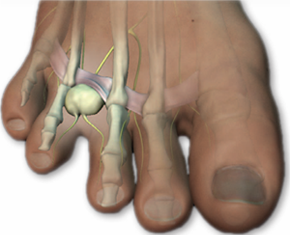
Morton's Neuroma


Neuroma is a term used to describe the enlargement or thickening of the tissue that surrounds the nerve. Morton's neuroma is entrapment & irritation of the interdigital nerve which passes between 3rd & 4th metatarsal bones. Hence it is also termed as intermetatarsal neuroma.

SIGNS & SYMPTOMS:
  • Pain on weight bearing - a shooting pain affecting the contiguous halves of two toes. Sometimes there may be a dull pain rather than a sharp one. 
  • Burning
  • Numbness
  • Paresthesia - tingling, pricking, or numbness with no apparent long-term physical effect. Commonly known as pins-and-needles.
  • A sensation that something is inside the ball of the foot
Causes:
  • High-heeled shoes - especially those over 2 inches (5cm), or a pointed or tight toe box which
    squash the toes together. This is probably why the condition is much more common in females than in males.
  • High-arched foot.
  • Flat feet.
  • A bunion.
  • Hammer toe.
  • Some high-impact sporting activities.
  • Injuries - an injury or other type of trauma to the foot may lead to a neuroma.


Treatment:
  • Resting the foot.
  • Using an ice pack on the affected area.
  • Changing footwear- wearing shoe according to foot size like wide shoes & or no heeled shoes.
  • Orthotic correction (Arch support)-  The arch support of the foot, removing pressure from the nerve. The doctor may recommend a custom-made, individually designed shoe-insert, molded to fit the contours of the patient's foot. 
  • Modifying activities - avoiding activities which put repetitive pressure on the neuroma until the condition improves.
  • Body weight management - if the patient is obese the doctor may advise him/her to lose weight. A significant number of obese patients with foot problems, such as flat feet, who successfully lose weight experience considerable improvement of symptoms.