Saturday, 28 October 2017

Runners: Are you on right track…?


“You know you are a runner when your running shoes are the most expensive shoes you have”

Above line is absolutely true for runner. But expensive shoes doesn't assure that it will be right shoes for your feet. Achieving your desired goal for marathon needs consistent efforts & dedication. Injuries are not new for runners.  These injuries are barrier for your training. Many times you assume that injury&/pain is happening due to excessive running for which your body is not habituated yet. But few injuries become long term like IT band syndrome, Achilies tendintis, Plantarfascitis(Heel Pain) etc. Right medical advice can help you on time to time recovery.

Sometimes person has to give up their passion of running which is very disturbing for runners.

This article is an attempt to give you new insight for your running injuries. Marathon running is a quest in which so many people help you to understand your body Physiotherapist, dietician, trainers and last but not the least Podiatrist are those expertise to  whom you approach after getting any injury. Mentioned above all expertise you are aware but may not be aware of Podiatrist. Podiatrist we can say are foot doctors. Dear runners your feet are most important in living your "pace passion".

"Podiatry is the field of medicine which deals with most important aspect of running i.e. shoes & orthotics."

Yes you are right I am talking about Podiatry science. 

Dear runners your feet are so much important to live your pace and passion
.
Podiatry is a branch of medicine devoted to the study of diagnosis and treatment of disorders of the foot, ankle and lower extremities.

Most of the runners experience pain in calf, shin, heel even knees apart from that blackening of toe nails are few common problems which can be treated with Podiatry.


Am I Pronator/Supinator? is common question asked by patients who are runner.

This image is self explanatory about how to identify whether person is pronatory/supinator.


COMMON FOOT RELATED CONDITIONS WHERE PODIATRY CAN HELP:

  • Pain in calf muscles: Typically described as tired aching legs. Because of faulty foot posture (Flat feet or high arch) can reduce efficiency of calf muscle.
  • Toe nail blackening: Many runners use one size bigger shoes with misconceptions that foot swells after running. Due to this foot slide inside the shoes & can lead to blackening of toe nails. This way using tight or loose fitting shoes both can lead to blackening of toe nails.
  • Achilles Tendinitis: Further calf muscles can get strained at its insertion which is back side of heel which is called as achilies tendinitis. To know more click here...
  • Plantarfascitis: Pain below heel which aggravates after rest initially. Later it also aggravates after running certain distance. Pain is due to inflammation of plantar fascia which is ligament below the feet. To know more click here...
  •  Ankle pain: While running you may land up in ligament injuries. High arch person (Supinator) is prone for straining of ligament/muscles on outer side of ankle. Overpronators can injure inner side of ankle. Sometimes patterns are variable depend on many factors like tibial varus/uneven terrain. To know more click here...
  •  Shin Pain: Pain in inner/outer side of shin area known as shin splints. Including alignment issue, calf tightness and running surface also causing factor for the pain
  •  IT Band syndrome: Runners are very prone to ITB (Ilio Tibial Band) injury deu to following factors.
  1.  Narrowed stance in running and loss of double limb support
  2.  Fatigue of the hip abductor group producing a “droopy pelvis”
  3. Female runners are more susceptible to ITB problems due to slightly wider pelvis

Apart from above knee pain, back pain is also very common in runners and closely related to altered lower limb biomechanics.

ORTHOTICS Vs INSOLES:

Many people pick up off the shelf available insoles & feel that they are sorted with their flat feet/any foot correction. But it is absolutely wrong. Orthotics need to customize as per your particular foot alignment which is expertise task.

Podiatrist need to do through evaluation of lower limb biomechanics & then design orthotics accordingly.  As mentioned earlier it’s not only pronation/supination issue but alignment all proximal joints is important.

Before making orthotics it is important to be sure that your running shoes are appropriate. Following is basic guideline for shoes.
  1. Basic shoes test:  There are few basic shoe tests are necessary, before going in arch pattern.

  •  Flex Test—by pushing down on the shoe, the breakpoint, should be firm but not provide
    significant resistance.   
  •  Torsion Test—by twisting the shoe in opposite directions, this will check the stability of the soling.  If the shoe twists over on itself, inadequate support.

  • Counter Test—by grasping the heel of the shoe, apply pressure to the heel counter with your finger.  If the counter collapses with little/no resistance, the shoe is not supporting the heel.
2. Shoe size: Shoes should appropriate to your foot size as well as width. If your foot is broad then you should buy Wide shoes & not a size bigger. 


After wearing shoes there should be thumb nail gap between shoe front & your longest toe.


With proper traning, right shoes and orthotics can drastically boost your performance. V-Care Clinic is working in the field of Podiatry since many years. We follow guideline provided by UK Podiatrist. To know more about your feet & posture visit us.

Our Address.


Tuesday, 25 July 2017

HOW PODIATRY: AN INNOVATIVE SOLUTION TO ANKLE, FOOT AND LOWER LIMB PROBLEMS


Podiatry must definitely be a new word for many people among us. But before we get into the details of Podiatry, let's answer the question that why is there a need to gain knowledge about foot or problem related to it ??? As we have commonly known that while constructing any structure it is essential for the basement to be strong and sturdy. Taking this fact into consideration, we infer that when it comes to the Human body, the Foot is that important base which is needed to perform the human functions of mobility and stability. There are 26 bones, 33 Joints, 107 Ligament & 19 Muscles which are intricately connected to each other to complete the anatomy of foot.  Hence, if the alignment of the base i.e. the foot is affected it will have repercussion that will affect our postural alignment. But unfortunately, most often, this amazing structure is neglected & not given the care & attention it needs.

Standing and walking are integral part of our daily routine. However, people do not give heed to foot problems until it hampers their standing or walking routine severely. This is the fundamental reason foot problems are not easily treated and hence are ignored. However, ignorance is not always bliss. Since our feet & the ability to move is what demarcates the difference between INDEPENDENCE & DEPENDENCE.

Podiatrist is a doctor who specialized in treating conditions related to foot, ankle and lower limb. Consequently, the medical science of diagnosis and treatment of foot, ankle and lower limb related problems called Podiatry. Although still an alien term, Podiatry has been in practice since early 1900s in America, Australia & Europe.


FOOT SCREENING
Now that we are acquainted to & agree on the importance of foot. Let’s get an insight on some common signs which will help you to identify any foot related problem and screen yourself. So you can check for yourself for following signs.

Other Toes
LOW BACK PAIN AND KNEE PAIN


The human musculoskeletal system can be considered facsimile to a chain link. If the position of any one end is changed or if anyone links, is broken, then it will damage the entire chain link.  Thus, altered foot alignment can result in knee pain & back pain. Therefore, there is an interconnectivity between the foot, knee and spine.


Diabetes is a multi system metabolic disorder which even has its implications on the normal functioning of foot. However, the treatment of foot complications related to diabetes is an entirely different domain (elaborated in previous article)
    It causes two major problems in feet

WHAT DO YOU DO NOW?

In case you have incurred any of the above enlisted problems, who do you approach for the same. The answer is a Podiatrist.

HOW DOES IT WORK?

Before starting the treatment it is essential to identify the root cause, which can only be known after a thorough assessment. This assessment involves the following-
•       Understanding the patient’s complaints & lifestyle.
•       Visual inspection of FEET- Skin Condition, Colour, Corn/Callus/Ulcer
•       Gait Analysis.
•       Foot sensation.
•       Measure foot size- Length & width.
•       Inspection of the patient’s footwear.

THE INNOVATIVE SOLUTION
Once you understand the main reason of the problem, Podiatry line of treatment includes following-
  1. Shoes: Appropriate shoes as per patients problem &  lifestyle demand, Doctor will guide you about sports shoe specifications, size & other details.
  2. Prescribe corrective Orthotics:
The main solution is corrective Orthotics (also known as insoles). Use of such orthotics helps re-align the body in a corrected posture & thus provides a long-term solution without any side effects.

COMMON FOOT RELATED CONDITIONS WHERE PODIATRY CAN HELP:


Tuesday, 2 August 2016

Success of Occupational Therapy.


This is a result of my patient who was diagnosed as "AUTISM". He has shown great improvement. To reach this moment it took almost one and half year. This is his first result without promoting him; off course it's my result too. Thanks to his parents for faith and their patience..

Monday, 28 September 2015

Other Problems

KNEE PAIN

Knee Pain

As explained earlier, foot is the supporting structure/ base of the human body. Any change in the alignment of foot will reflect its effects on other proximal joints.
Knee Deformities

 Most commonly people suffering from flat feet are more prone to knock knees (Genu Valgus) deformity in the knee joint which affects outer compartment of knee joint whereas people with high arch are susceptible to bow legs (Genu Varus) deformity which affect the medial compartment of the knee joint.

LIMB LENGTH DISCREPANCY (LLD) & BACK PAIN

The human body is an epitome of balance. If there is any deviation from this balanced state the system go into malfunction. The same holds true while considering the length of lower limb. If there is any difference in the length of the two limbs, it alters the position of the pelvis. This in turn affect the spine resulting in Scoliosis i.e. tilting of the spine on one side.

In severe cases along with the spine the ribs also undergo rotation causing a rib hump. Once the vertebral bodies start rotating the spinous processes deviate more & can even compromise the respiratory capacity in sever case.

Treatment:-
If the reason for the scoliosis is LLD then it is advisable to detect the exact length of discrepancy. This can be corrected by adding the exact amount of compensation in the footwear to prevent further deterioration of the spine. Another important aspect is physical therapy intervention to maintain the flexibility & strength.

ACCESSORY NAVICULAR BONE

Accessory Navicular Bone
Accessory Navicular bone is a congenital condition in which an extra bone or cartilage which is present next to the Navicular bone on the inner side of  foot just above the arch region. In most of the cases it is undiagnosed as it does not give rise to any symptoms.
Accessory Navicular Bone
However a few percentage of people with accessory navicular develop a painful condition called as Accessory Navicular Syndrome.

Causes:-

  • Recurrent trauma to the ankle or foot such as ankle sprain.
  • Improper size & pattern of footwear which causes friction against the extra bone.
  • reduction in arch.
  • Injury to Tibialis posterior tendon.
Symptoms:-
  • Redness & swelling over the inner side of the foot in the arch area.
  • Pain on palpating the area of extra bone.
  • Pain while walking & standing activities.

CALCANEAL APOPHYSITIS


An apophysis is a growth plate which is present at the end portion of the bone when there is no accompanying bone, Calcaneal apophysitis is an inflammatory condition which affects the growth plate present in the heel bone (Calcaneum). It usually occurs in kids falling in the age group of 8-14 years as till the age of 14 years the growth plate continues to grow. Repeated stress or trauma to this sensitive area results in inflammation & damage to the growth plate.


Causes:-
It is most commonly seen in kids participating in sports which result in high impact over the heel area which ultimately damage the still underdeveloped growth plate. Furthermore kids who have other alignment issues such as flat feet or high arch are more susceptible to this damage.

Symptoms:-
  • Pain in the heel area.
  • Excessive pain on squeezing the sides of heel.
  • Pain on standing or walking which become worse as the time increases.
  • Limping
  • Inability to perform activities such as running, jumping & skipping.


Thursday, 17 September 2015

CORNS AND CALLUSES


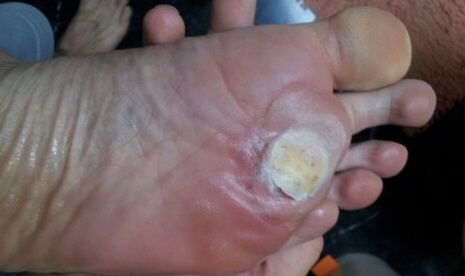
Painful Corn
Calluses are an area of hard skin that becomes tough due to exposure to excessive friction, pressure, or irritation. Callus can occur anywhere in the body which exposed to undue friction. The most common area is the sole of the feet, great toe & fifth toe. There are certain areas over our sole which bear more weight compared to the others. This is the area that undergoes more friction with the walking surface or the footwear & over time develops into a callus. These areas of more pressure are dependent on our arch & walking pattern & differ for every individual.

Corn & Calluses
When a callus has been long-standing, it converts into a Corn. A Corn is deeply rooted & can be considered similar to a funnel i.e. it has a narrow & deep-seated root & a broad base. Most often corns are painful & render walking & standing quite difficult even for the daily tasks.
The development of corns and calluses is independent of any other systemic disease such as diabetes and can affect almost anyone. Although if a diabetic patient incurs corn or a callus then it should be dealt with more precaution to avoid complications such as infection or wound.

Treatment:

As elaborated above, calluses are the result of undue pressure. Therefore unless this pressure is reduced, the callus or corn will keep or re-occurring. Stooping friction & offload the corn by using orthotic corrections as per the Podiatrist's advice is the only safer treatment.
It is strictly un-advisable to use corn caps as it contains Salicylic Acid which is harmful to the normal & healthy skin surrounding corn thereby increasing the diameter of the corn.
Corn Cap results
It is also wise to avoid performing any bathroom surgery for corn removal as the chance of infection is quite high.
Don't use corn cap & stop doing bathroom surgery

Success Story Of recurrent Corns-1


TIBIALIS POSTERIOR TENDINOPATHY

Tibialis Posterior Tendinitis/ Tendinopathy is also know as Posterior Tibial Tendon Dysfunction (PTTD). The tendon of Tibialis posterior muscles is one of the most important supporting structures for the arch of the foot. This muscle originates from fibula & inserts over the medial cuneiform & navicular bone.
When the function of this tendon is impaired, it alters the walking pattern & is unable to provide adequate support to the arch. If left untreated overtime this muscle loses it's integrity & the arch collapses. This is termed as 'Adult acquired flat feet.
If the person continues to walk in this pattern it leads to outward deviation of toes & rolling inwards (Pronation). Therefor early treatment is advisable.

Treatment
  • Reduction of inflammation over the tendon.
  • Use of ankle brace while walking during the initial period to support the tendon & allow it to heal.
  • Physical Therapy exercises to reduce pain & strengthen the muscle to prevent further complications.
  • Use of corrective orthotics to prevent the arch from collapsing completely.